'High denomination cash notes which was 1.4 lakh crores of Rs 500 and Rs 1,000 notes in 2004 became Rs 15.5 lakh crores in 2016.' 'If it had been allowed, by 2022, it would have been Rs 34 lakh crores, and that would have been the end of the Indian economy.' 'Demonetisation was a huge hit on the head of the economy, but without the hit, you could not U-turn the economy.'
The government has made it much harder for tycoons to get special dispensations from Delhi
'It is very much a danger.' 'With Tibet following the India tradition of ahimsa and the global visibility of the Dalai Lama who embodies these values, he should be supported by India as a diplomat.' 'It would be in India's self-interest and instead of being embarrassed about his presence, India should recognise this (role).' 'By appeasing China, India does not get anything in return; they (the Chinese have not stopped) claiming Arunachal, part of Kashmir, etc.'

According to a new report published by Switzerland-based BIS, which is also referred as 'bank for central banks', the US Federal Reserve's announcement of a possible phasing out of easy money regime has resulted in 'abrupt and sizeable' equity market losses in both advanced and emerging markets.

India will require new technical solutions and approaches to solve environmental problems.

Gandhi had on Thursday hit out at Prime Minister Narendra Modi accusing him of "hiding behind the blood of soldiers".

The Kashmir-based PDP's linkage with the BJP could even be a turning point, provided it is safeguarded against real possibility of miscarriage. So-called fringe elements on either side, more so in the Saffron parivar, can easily upset Modi-Mufti applecart. They have only to drag contentious issues into limelight to do that, says Mohammad Sayeed Malik.
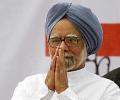
The most immediate cause of worry is the recent volatility in foreign exchange markets, Prime Minister Manmohan Singh tells the Assocham annual general meeting.
.jpg)
The catalyst is the run on emerging market equities, but many investors are just tired of waiting for India to get its act together.

Over to the government how they manage the uncertainty of monsoon and revive spending in order to entice RBI for another round of rate cuts

Rediff.com's Love Guru has answers to all your relationship problems.

After Pyongyang tests a missile potentially capable of reaching the US, Dr Rajaram Panda explores the realistic -- and peaceful -- options before Donald Trump and the international community at large.
'The Ganga must be kept above all divisive politics,' says Uma Bharti.
Here's a look at how key Tata group companies fared under Cyrus Mistry's stewardship.

Analysts say the Sun Network's fundamentals may be sound but the troubles faced by Maran have caused a lot of volatility.

'To identify with the common man, Modi had to look like one.' 'The disastrous suit with his name written on it never made its reappearance.' 'Frequent dress changes during the day, which led Arvind Kejriwal to calculate that Modi spent crores on his attire ever year, too stopped.' 'Instead, a newer Modi emerged: Humble and eager to serve.' Narendra Modi has cleverly repositioned himself as a man of the masses in the past three years, says Aditi Phadnis.
Customs and excise duty rates have been amended mainly to promote Make in India.
Penpix of the India squad for the 2015 cricket World Cup, which is being held in Australia and New Zealand.

The prime minister's visit to Washington should focus more on shopping for energy security and stopping the US from snooping on us, reigning in its popular and innocuously operated instruments to gather intelligence like Google, says Tarun Vijay.
India is set for decent growth in 2015.
Last week, the government had introduced a fresh round of austerity measures, including bans on first class travel, creation of new posts and holding meetings in five-star facilities.
From a ruling party's perspective, the BJP is in a sweet spot; editorial independence and analytical coverage of governance is rapidly declining

The success of the government will depend substantially on the quality of its team of key ministers, officials and advisors
John Elliott, the author of Implosion: India's Tryst with Reality, on his Riding the Elephant blog, says the sacking of Cyrus Mistry as chairman of Tata and Sons was in line with Ratan Tata's personal style of dealing with executives

Deepak Parekh, chairman of Housing Development Finance Corporation (HDFC), India's largest mortgage lender, says the exuberance in industry about the new government is justified but big ideas articulated by the prime minister need speedy implementation.


A large chunk of the Rs 8.8 lakh crore of investments the Patnaik government had attracted is in uncertain territory.

Money is being released and the government knows it will have to front-run private investment.

The state is trying hard to improve ease of doing business by several notches.

'Today, three areas give banks a big headache -- steel, power, infrastructure.' 'Three Cs are very critical in lending -- character, capacity and collateral of the borrower.'
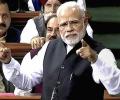
Replying to a debate on Motion of Thanks on the President's Address which was adopted by the House later amid walkout by Congress, he replied point-by-point to the issues raised by the Opposition, including surgical strikes and allocations for Mahatma Gandhi National Rural Employment Guarantee Act, agriculture sector and for Scheduled Castes. Opposition had moved 190 amendments to the Motion which were negated.

Once these banks start showing losses, they will not be able to pay dividends to the government nor pay taxes, which will further aggravate the situation for the government as its return on investment as an investor would be very negligible for the next few years, says M V Subramanian.

Modi government needs to focus more.

Former President A P J Abdul Kalam kindly answered rediff.com's questions for an exclusive interview.

Biometric authentication is based on the unscientific and questionable assumption that there are parts of human body that does not age, wither and decay with the passage of time.

Because of India's weak fiscal position, the plethora of debt-burdened infrastructure companies and the poor asset quality of public sector banks, economic growth in 2015-16 may be limited to about six per cent, say Shankar Acharya.

The media has given the PM and his government a far easier time than it probably deserves.
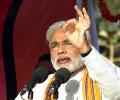
The kind of people Narendra Modi has chosen, the decisions he has taken and the rail and central budgets suggests that he is treading carefully in New Delhi. There is less of innovation and more of continuity, so far. He is not ready to rock the boat and start from scratch, says Sheela Bhatt.
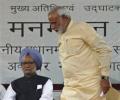
In his much-hyped swansong, Prime Minister Manmohan Singh proved that though he is months away from retirement, he still has quite a bit of fight left in him.
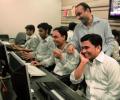
Over the past two decades, India has evolved economically as well as from the market's perspective.
 © 2026 Rediff.com - Advertise with us - Disclaimer - Privacy Policy - Sitemap - Feedback - About us - Terms of use - Grievances